TID #6
Time for the final TID, #6. It was approved in June, 2024 so there is very little in the way of actuals. Instead, we'll focus on the proposal itself. It'll be fun with this one to ask "How would you vote?" without the benefit of hindsight.
The map shows the area, which looks a lot like a gerrymandered Congressional district. The parcels along Rt 32 are included in the TID map because the proposal has "contingent projects" to improve that section of town. They are contingent upon the TID performing well enough to support them without extending the TID.
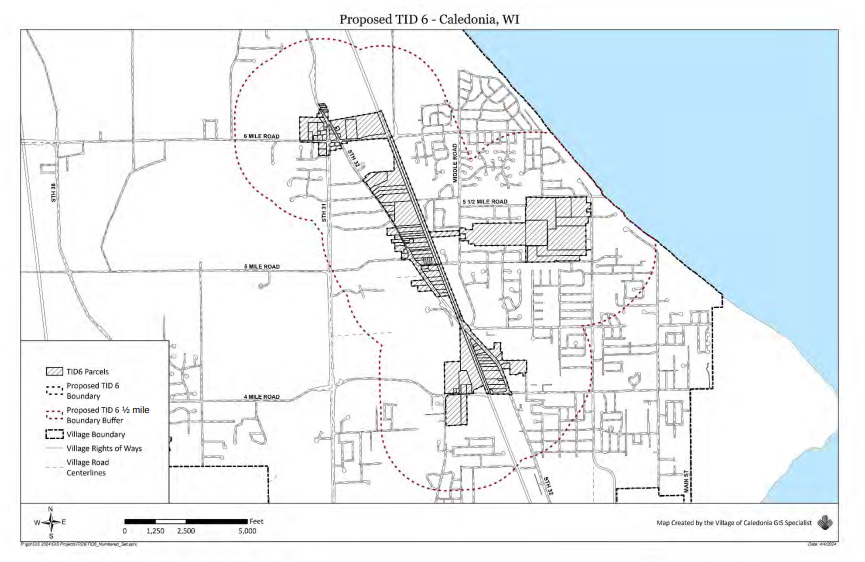
The proposed development is for 3 subdivisions with a total of 254 homes. Construction starts in 2025 and ends in 2032.
Project costs are estimated at $43.9M, $29.8M of which are developer incentives. Village contingent projects are $12.2M.
Incremental valuation is estimated at $122.9M. Tax increment would rise to its max of $2.2M by 2032. The village's portion of that $2.2M would be $740K per year.
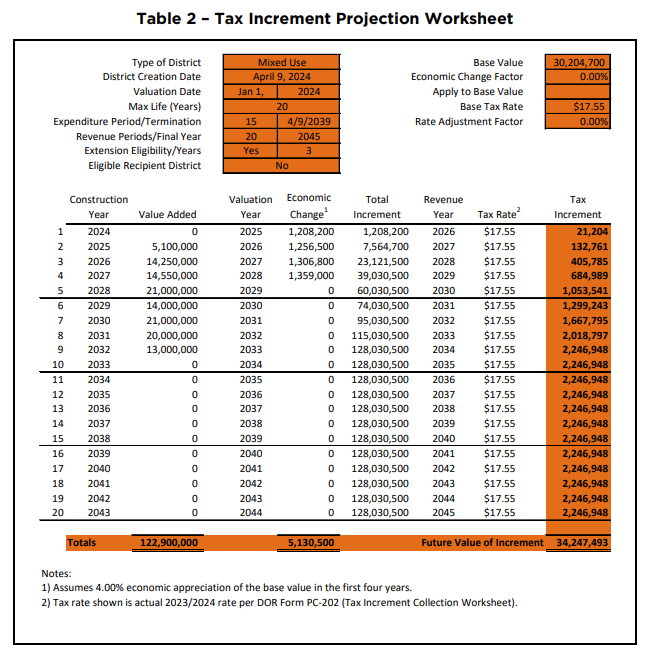
Target close is 19 years.
How would I vote on it?
Leaning strongly toward No because of the outsized developer incentive, but here are the questions I would ask:
Why wouldn't the project be economically feasible without developer incentives? Are the prices in the immediate area too low? Does subsidized development artificially cap prices of existing homes?
Under what conditions would the developer incentives vary from the estimate as the proposal says on p 61?
$29M divided by 254 homes is $114K per home. Really the project isn't feasible w/o that kind of incentive?
Why are the village's contingent projects even in the TID? If they are important to the Village, why aren't they funded outside the TID?
It's June 2024, how confident are you that $5.1M will materialize in new valuation in 2025?
Where will $21K in tax increment come from in 2024?
What is the 4% economic appreciation in the first 4 years of the worksheet in table 2?
As with all other TIDs, development forecast seems to start quickly and stay consistent through the first several years. Reality has not shown that to be the case. What gives us confidence that the development will start as projected?
What is the schedule relationship between the initial infrastructure work and the developer's construction start date? Finish-to-start? Overlapping? Does the developer have any commitment to start on a certain fixed or relative date?
What is the ongoing planning & administration expense and who is doing it?
How sensitive are the financials to number of homes built? I.e. if we do the infrastructure work, what's the minimum number of homes that have to be built to make it economically viable for us?
Residential development brings people who need services (police + fire). Since this is in a TID, incremental tax revenue will not be available for those services for 19 years. Does that concern our fire or police chief? Can we provide adequate support to 254 new homes without incremental service expense?
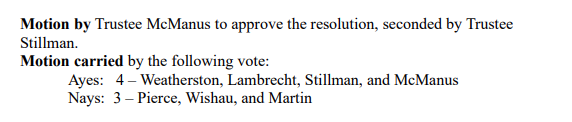
How did the vote go?